

Ihor Smeshko: Two world wars have already been a warning, and the phantom of a third one still lingers
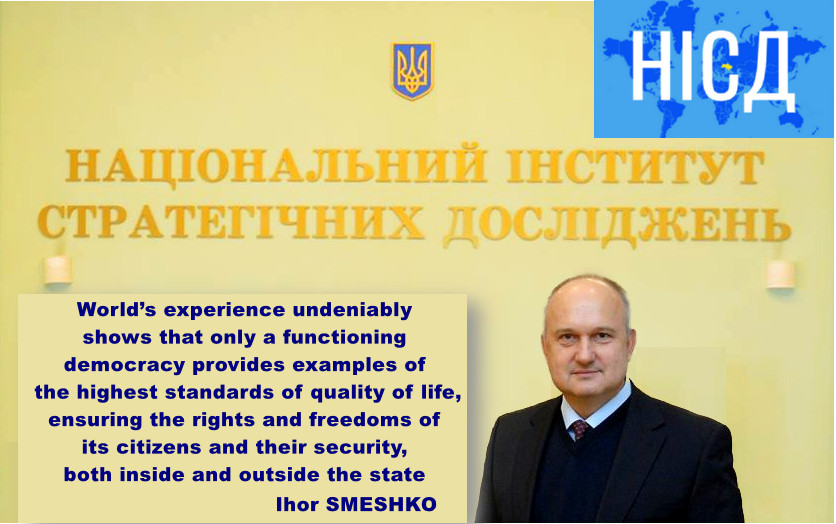
This is a translation of Ihor Smeshko’s speech, President of the Center for Strategic Studies and Analysis, about the balance in the world, serious crisis in the Euro-Atlantic civilization and the place of Ukraine in the processes of global transformations and crises in the modern world fourteen years ago
Ukrainian version: https://sylaichest.org/igor-smeshko-dvi-svitovi-vijny-uzhe-buly-poperedzhennyam-a-fantom-tretoyi-shhe-dosi-ne-znykaye/
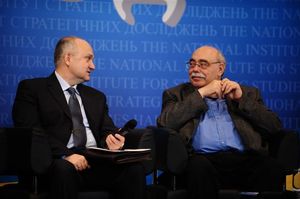
Report of the President of the Center for Strategic Studies and Analysis at the conference held by the National Institute for Strategic Studies on March 30, 2012, on the topic: ‘National Strategies in the Era of Global Transformations’ and ‘Global Crisis – a New Role of National Strategy and Governments’ organized by the National Institute for Strategic Studies on the occasion of the 20th anniversary of the Institute.
“Dear colleagues, guests, audience!
It is a well-known fact that since the time when different civilizations of people appeared on the planet Earth, there has been a process of their transformation, as well as attempts to spread their influence to other nations and civilizations.
Essentially, this process is a struggle between two opposites: an attempt to dominate and a slow but gradual integration.
The inevitable crises that result from this struggle have previously affected the pace and quality of human development.
However, never before have crises in the development of individual civilizations been of such a global nature, systemic dependence of peoples, and put the survival of the planet as a whole at stake.
It is also characteristic that the depth of integration of individual civilizations, the unification of forms of government, religious views, and public morality inherent in each of them, and most importantly, the improvement of spiritual qualities and moral values of an individual have always lagged behind the pace of scientific and technological progress.
Even after many millennia of development of the universal civilization, the differences between worldviews and social and economic inequality between different nations on the planet remain extremely striking.
At the same time, the 21st century is characterized, in my opinion, primarily by the fact that the little changed inner nature of an individual human being is nowadays confronted with the fact that control over the resource and financial and economic base of the planet, on which the lives and fate of billions of its population depend, is increasingly concentrated in the hands of a few hundred of the world’s richest families.
Families that simultaneously concentrate control of the globalized media in their hands. This gives them, among other things, the ability to shape and manipulate the mass consciousness of entire nations.
While their true inner nature and culture, as well as human weaknesses and temptations, are usually hidden from the eyes of these peoples and are not much different from the rulers of the world of the past, such as the temptation of money and power over people.
But why didn’t global conflicts between nations, even in the recent past, lead to catastrophe and the end of human history? After all, two world wars have already been a warning, and the phantom of a third one still lingers?
Firstly, because all previous conflicts between nations, fortunately, did not involve weapons of mass destruction;
Secondly, because the first achievements of the scientific and technical revolution related to such weapons appeared in countries with democratic forms of government.
Thirdly, because soon an analog of such weapons appeared in the hands of the former USSR, thus breaking the monopoly of possession by one state.
The latter factor, unfortunately, remains underestimated.
Although the second factor played a very important role because if this weapon had appeared earlier in the hands of dictators, for example, Nazi Germany, the fate of humanity could have been different.
However, the fact remains that the democracy of the United States of America, as modeled in 1945, did not prevent the use of this inherently inhuman weapon against Japan.
On the other hand, this particular form of government, given the fact that, as a rule, in functioning democracies
– where there are three independent branches of government,
– over which there is some control by civil society,
– where there are media that are at least relatively independent of the government,
– and there is an opposition, and as a result, the process of state decision-making is formally balanced and objectively more balanced than in authoritarian regimes,
– at least allowed humanity to gain time to eliminate the threatening unipolar world in the nuclear sense.
Later, with the bipolar distribution of the world major powers during the Cold War, this left no chance for even the hawks of the average democratic governments in the West to be tempted by an easy victory over the enemy. It was the existence of these circumstances that maintained the balance in the world until recently.
But why is it that today, even the Euro-Atlantic civilization most decisive in terms of success in global scientific and technological progress, in developing the theory and practice of effective democracy has all the signs of a systemic crisis?
Why, for example, are other nations of the world – Asian, Arab, African – so eager to share in the achievements of Euro-Atlantic scientific and technological progress and, at the same time, extremely hostile to the imposition of Euro-Atlantic forms of democracy on them by force?
Because all nations and civilizations have their own historical paths, destinies, and the right to their own philosophies and moralities.
To their own path to God as well.
First, let’s define what the Euro-Atlantic civilization is and what it consists of, with democracy as one of its most valuable achievements.
In my opinion, it rests on three main components—three key pillars, if you will:
– firstly, it is based on the culture and philosophy of ancient Greece;
– secondly, it is based on the theory and practice of state-building and the foundations of the legal culture of ancient Rome;
– and, finally, thirdly, it is based on the foundations of Christian morality and religion.
It is difficult to imagine the further development of this civilization into modern forms of Euro-Atlantic democracies without the decisive influence of the European Renaissance, the Reformation, and the bourgeois revolutions of the 17th-19th centuries.
In legal terms, without the Magdeburg Rights and the Napoleonic Civil Code.
In economic terms, without evolutionary and peaceful transformation, under the horror of the example of expropriation during the Russian Revolution of 1917, of the original ‘predatory’ European capitalism of the 19th century, into modern forms of socially oriented market economies, with flexible state regulation and an active role of the middle class.
But, in my opinion, perhaps the most decisive factor that stimulated the progress in the emergence of modern forms of democracy and modern forms of market economies in the West was that it was stimulated by fierce competition and confrontation with the world communist system since the beginning of the 20th century. The price of the issue was the existence of one system or the other.
The struggle between these two opposites prompted the West to constantly improve its economic and political development model to ensure internal stability and public support for the actions of its governments to win the economic, political, and defense competition with the USSR.
The collapse of the USSR and the victory of the West in the Cold War seems to have played a cruel joke on the victors themselves. It has led to a slowdown in the process of improving the forms of state and economic governance in these countries, as well as to the temptation to maintain high social standards of living in their countries at the expense of others…
But where does Ukraine stand in these processes of global transformations and crises in the world today?
In my opinion, where it is is in the center of Europe.
In the pan-European, Euro-Atlantic civilization, even though it is currently experiencing a serious crisis. First of all, a demographic and moral crisis.
According to unofficial statistics, there are no more than 10 percent of the white race left on the globe today.
Without realizing it, Old Europe needs our help at this time, no less than we need it. Any attempts by our esteemed and venerable European relatives to rest on the laurels of their fathers and ancestors as rentiers of their past world achievements are a very dangerous illusion. A vivid example of this is the economic crisis in Greece, the economic problems of Italy and Spain, and the social and demographic issues of Britain, France, and Germany.
Artificially preserving the Third World as a raw material appendage and cheap labor force, as well as radically stopping migration from the world poorer countries to the richest ones, is like trying to change the law of gravity. Furthermore, attempts to gain control over strategic resources under the slogan of spreading European forms of democracy worldwide may cause a reverse, asymmetrical power reaction…
I think it is time to transfer the stereotypes of the Cold War to the archives, especially about the division of Europe into the West and the East.
These days, elements of a potential global conflict are more likely to be seen not along the line of East versus West but rather along the line of poor South and rich North.
The Slavic peoples of Europe have remained the last reserve of Euro-Atlantic civilization, with a huge potential for inner Christian morality and a sincere desire to realize it for the benefit of the whole world.
So, there can be only one national strategy for Ukraine’s development today – building a developed and functioning form of European democracy in the country.
With a market-based, socially oriented economy, a strong middle class, and a developed civil society.
With limited state regulation of strategically important industries and agriculture and preservation of its own defense potential.
Only this can give us a strong state, a strong economy, and a prosperous society, and most importantly, happy and free citizens in our country, capable and motivated to defend it in case of danger.
Because without a strong middle class, a functioning civil society and independent branches of government under its control, there is no free citizen of the state. And without it, true democracy cannot exist.
Thomas Jefferson, the father of the Declaration of Independence of North America, is credited with the following statement: “True independence, freedom, and democracy are not toys to be given to children.
It is a very serious thing, which can be enjoyed only by highly educated, strong, and courageous people, for whom personal dignity is the most courageous feature of human life.”
By contrast, the world’s experience undeniably shows that only a functioning democracy provides examples of the highest standards of quality of life, ensuring the rights and freedoms of its citizens and their security, both inside and outside the state.
We simply have no other way.
Moreover, this is a historic chance for Ukraine to become a link and a donor and, finally, an active political player in building a new security space.
Thus, we aim to contribute to the completion of the unification of Europe and the Euro-Atlantic and to make our historic contribution to the continuation of the peaceful and evolutionary process of interpenetration and gradual integration of the world civilizations.”
Ukrainian version: https://sylaichest.org/igor-smeshko-dvi-svitovi-vijny-uzhe-buly-poperedzhennyam-a-fantom-tretoyi-shhe-dosi-ne-znykaye/
Read on this topic:
IHOR SMESHKO | A PEACE PLAN FOR UKRAINE AND THE WORLD
Ihor SMESHKO. Europe cannot be secure without Ukraine’s security
OPINION: Ihor SMESHKO. Budapest Memorandum Revisited: A Manifesto (Kyiv Post, May 10, 2025)
свіжі новини
Нехай світло Воскресіння наповнить наші серця силою, вірою та незламною надією. Нехай Господь благословить і оберігає кожного з нас та нашу Україну, дарує впевненість у нашій неминучій Перемозі у ...
12.04.2026Протягом цілого покоління Україна, попри значний людський і ресурсний потенціал, залишалася однією з найбільш уражених кризами країн Європи. Це має змінитися після війни.
06.04.2026Важлива і змістовна подія відбулася у Національній університетській бібліотеці Страсбурга — одному з провідних інтелектуальних осередків Європи. Під час зустрічі з новим директором бібліотеки ...
31.03.202627 березня 2026 року Держсекретар США Марко Рубіо на зустрічі з міністрами закордонних справ країн G7 заявив: “Україна – це не війна Америки, і тим не менше ми зробили в цю боротьбу більший ...
29.03.2026